
Macon County Arrest Records and Charges
Macon County arrest records are created on the law-enforcement side. The Macon County Sheriff's Office is the local agency for county-level detention, service, warrants, civil process, enforcement records, and many arrest records. The Sheriff's Office is located at 1820 Lakeside Drive, Franklin, NC 28734, and the listed phone number is 828-349-2104. Arrest and booking records should not be confused with the court case file kept by the Clerk of Superior Court.
The court charge record begins when criminal process or a charging document becomes part of the court case. A charge record can show the offense charged, statute or code section, offense date, arresting agency, warrant or citation number, bond condition, court date, and case number after filing. The full case file later shows how the charge ended, such as dismissal, plea, conviction, acquittal, sentence, or appeal. Live jail custody belongs with inmate and detention channels, while the full case outcome belongs in Macon County criminal court records.
The Sheriff's Office source is shown in the image from the Macon County Sheriff's Office official page.
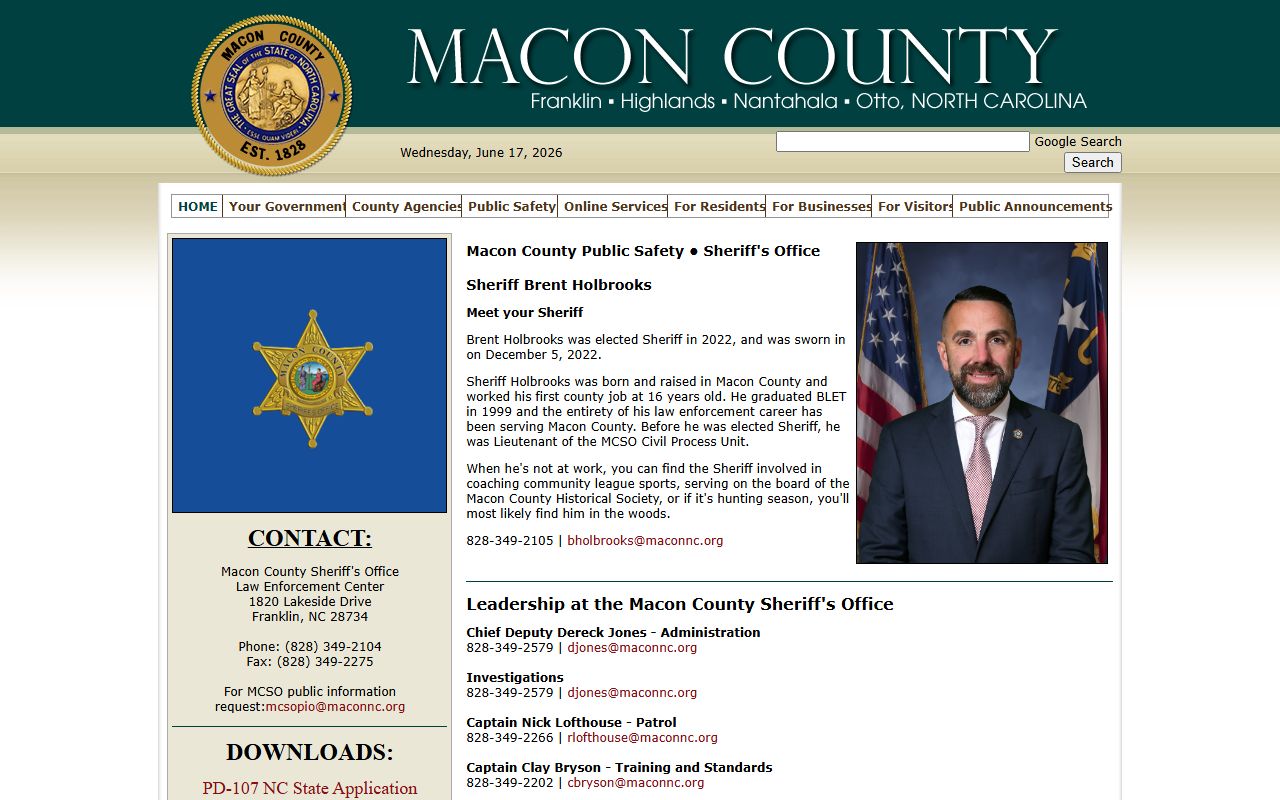
The Sheriff is the starting point for arrest and enforcement records, while filed court charges move through the Clerk and eCourts.
Find Macon County Arrest Records and Charges
No official county-hosted public jail roster with searchable fields was located in the accessible Macon County sources reviewed. That means this page should not promise a mugshot database or send searchers to unofficial jail-roster sites. The official chain is to contact the Sheriff's Office for current arrest, detention, or booking questions; use eCourts Portal for filed charges; use the court-date search for scheduled appearances; and contact the Clerk for certified copies or older court files.
- For live custody or booking questions, call the Macon County Sheriff's Office or Detention Center through 828-349-2104.
- For filed criminal charges, search the eCourts Portal by defendant name, case number, citation number, or date range.
- Filter to Macon County when a county or location field is available, because eCourts searches can be statewide.
- Open the case detail and compare the charge list, offense date, court date, bond entry, and disposition status.
- Use the Macon County Clerk of Superior Court at 828-349-7200 for certified copies or records not visible online.
If a person may have moved from local jail to state custody after conviction, the North Carolina Department of Adult Correction offender search is the state-prison and supervision channel. It is not a Macon County arrest log and does not replace the local court charge record.
Macon County Charges After Arrest
Charges after arrest may begin through a warrant, citation, magistrate's order, information, indictment, or other criminal process. The District Attorney represents the State in criminal cases, reviews law-enforcement charges, handles plea negotiations, prepares cases for trial, works with victims, and appears in Superior Court and District Court sessions. Macon County is associated with Prosecutorial District 43, and current district contact details should be verified through the Judicial Branch directory.
| Charging Document | Who Uses It | How It Fits the Record |
|---|---|---|
| Complaint / Citation | Often tied to officer or magistrate process for lower-level charges, traffic, or misdemeanors. | Can start a District Court case and create a court date or payable citation path. |
| Information | Filed by the prosecutor in eligible criminal matters. | Sets out formal charges without a grand-jury indictment where allowed. |
| Indictment | Returned by a grand jury for felony prosecution. | Moves or confirms the felony charge path into Superior Court. |
The North Carolina arrest warrant and criminal process source is shown in the image from Chapter 15A, Article 5.
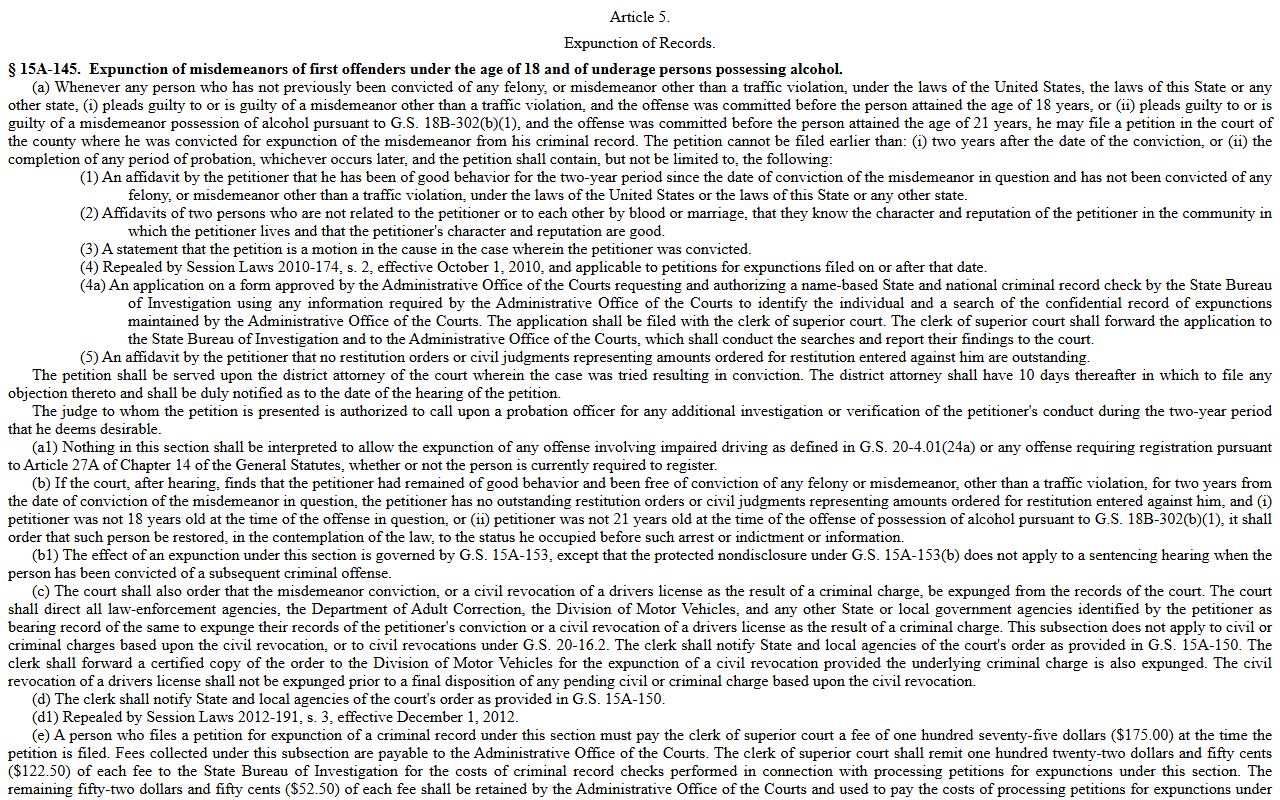
Criminal process is the legal bridge from an arrest or warrant to a court charge record that can be tracked in the case file.
Macon County Charge Status Terms
A charge can change after filing. The prosecutor may amend the charge, reduce it, add a related count, dismiss it, or proceed to plea or trial. A judge may enter orders that affect bond, release conditions, continuances, evidence issues, or final judgment. One arrest can produce more than one charge, and each charge can have a separate status.
| Status | What It Means | Why It Matters |
|---|---|---|
| Pending | The charge is open and has not reached final disposition. | Check future court dates and bond conditions. |
| Amended | The charge language, level, or statute has been changed. | Read the latest charge entry rather than only the first arrest allegation. |
| Reduced | The case moved to a lower offense or lesser level. | The final conviction, if any, may differ from the arrest charge. |
| Dismissed | The court record shows the charge did not proceed to conviction. | Dismissal is not the same as expunction. |
| Convicted | The defendant was found or pleaded guilty to an offense. | Review sentence, probation, costs, appeal, and later expunction limits. |
| Appealed | A party has taken the case or issue to a higher court path where allowed. | The final outcome may change after review. |
Macon County Charges vs Convictions
Being arrested or charged is not the same as being convicted. A charge is a formal accusation. A conviction is a court result after a plea, verdict, or other finding of guilt. Macon County court charge records may show charges that were later dismissed, reduced, amended, or ended in acquittal. Always read the disposition and sentence fields before treating the charge as a final outcome.
| Point | Charge | Conviction |
|---|---|---|
| Record Stage | Appears after arrest, citation, warrant, information, or indictment. | Appears after plea, verdict, or other court finding. |
| Meaning | The State alleges an offense. | The court record shows guilt was established. |
| Can Change | May be amended, reduced, dismissed, or superseded. | May lead to sentence, probation, costs, restitution, or appeal. |
| Search Risk | Easy to misread if disposition is ignored. | Still must be checked for appeal, expunction, or later order. |
Note: A Macon County arrest record may exist even if the related court charge was later dismissed.
Macon County Charge Codes
Charge records often use offense descriptions and statutory references. The statute or code section tells the reader what legal offense was charged. The severity level helps show whether the case is an infraction, misdemeanor, or felony. District Court generally handles misdemeanors and infractions, while felony matters can move to Superior Court for indictment, plea, trial, disposition, and sentencing.
Charge codes do not tell the whole story by themselves. A case may begin at one level and resolve at another. A felony charge may be dismissed while a lesser misdemeanor plea remains. A traffic-related arrest can have both traffic and criminal consequences. A probation violation can appear after the original conviction. The docket, charge list, disposition, and judgment must be read together.
Sheriff Records vs Clerk Records
The Sheriff's Office and Clerk of Superior Court serve different record roles. The Sheriff handles arrest, booking, detention, service, civil process, warrants, and many enforcement records. The Clerk handles filed court cases, court dates, judgments, certified copies, public terminals, dockets, indexes, minutes, and the court record after charges are filed. Calling the wrong office can delay a search.
| Question | Start With | Reason |
|---|---|---|
| Is someone currently in local custody? | Macon County Sheriff's Office / Detention Center | Live custody can change faster than the court docket. |
| What charges were filed in court? | eCourts Portal or Clerk of Superior Court | Filed charges are court records after a case opens. |
| Is there a court date after arrest? | Court-date search, eCourts, or Clerk | Scheduled appearances are court calendar records. |
| Can I get a certified judgment? | Clerk of Superior Court | Certified court copies come from the court custodian. |
| Can I request an arrest report? | Sheriff's Office | Law-enforcement records are not the same as the court file. |
Restricted Macon County Arrest Records
Arrest records and charge records can be restricted. Juvenile matters are limited by statute, court order, party status, and agency role. Sealed records may be hidden from public view. Expunged records are removed from ordinary public access through North Carolina's statutory expunction process. Adoption records, mental-health proceedings, protected addresses, minor information, victim information, Social Security numbers, and financial account numbers may be withheld or redacted.
| Point | Sealed | Expunged |
|---|---|---|
| Public Search Result | May show limited data or no public entry. | Should not appear as an ordinary public record after processing. |
| Legal Basis | Court order or confidentiality rule. | Chapter 15A expunction order for eligible records. |
| Who Can See It | Only authorized persons, agencies, or court-approved users. | Limited access under expunction law and related rules. |
| Where to Ask | Clerk for court files, Sheriff for law-enforcement records. | Judicial Branch expunction guidance and the court where the charge occurred. |
Macon County DA and Defense
Macon County criminal prosecutions are handled through North Carolina's Prosecutorial District structure. The District Attorney reviews charges submitted by law enforcement, decides how to proceed, negotiates pleas, prepares cases for trial, works with victims, and appears in criminal court. District information can change, so use current Judicial Branch listings rather than relying on an old name or unofficial directory.
Indigent defendants request appointed counsel through the court process. Public defense in North Carolina is administered through the Office of Indigent Defense Services and local appointed counsel structures where no dedicated local public defender office is verified in the research. The court decides appointment after reviewing eligibility. Victim notification is separate from public lookup; VINE may help with custody notifications, while the District Attorney's Office handles victim contact for prosecutions.
Macon County Arrest Charge Contacts
Use the office that owns the record. For arrest, booking, live custody, and enforcement questions, start with the Sheriff's Office. For filed charges, court dates, dispositions, judgments, and certified copies, start with eCourts and the Clerk. For a charge that may involve a warrant, missed court, or bond condition, confirm the court date and seek direct court or legal guidance before acting on stale information.
Macon County Sheriff's Office
1820 Lakeside Drive
Franklin, NC 28734
828-349-2104
Macon County Clerk of Superior Court
5 West Main Street
Franklin, NC 28734
828-349-7200