
How to Search Macon County Court Records
The main official search channel for Macon County court records is the North Carolina eCourts Portal. Macon County moved into eCourts Track 5 on July 22, 2024, so current public case lookup, hearing detail, and many electronic case records now route through statewide eCourts tools rather than a county-only database. The Portal can be used for public civil, criminal, domestic, estate, special proceeding, and infraction case information when the record is available for public display.
Use the most exact identifier available. A case number is cleaner than a name search. A citation number is best for many traffic matters. If the only question is when court is scheduled, the separate North Carolina court date search may be faster than opening the full case record. If a record does not appear online, the next step is the Macon County Clerk of Superior Court, not an unofficial search site.
- Open the eCourts Portal and choose the public search function that matches the information you have.
- Enter a case number, party name, business name, or citation number. Full names and date filters help reduce wrong matches.
- Filter to Macon County when the screen provides a county or location field.
- Open the matching case and review the caption, case type, hearing dates, docket events, status, and disposition fields.
- Contact the Clerk of Superior Court for certified copies, older files, sealed-record questions, or documents not shown online.
The official Macon County Judicial Branch location page is the source page for courthouse and local court links.
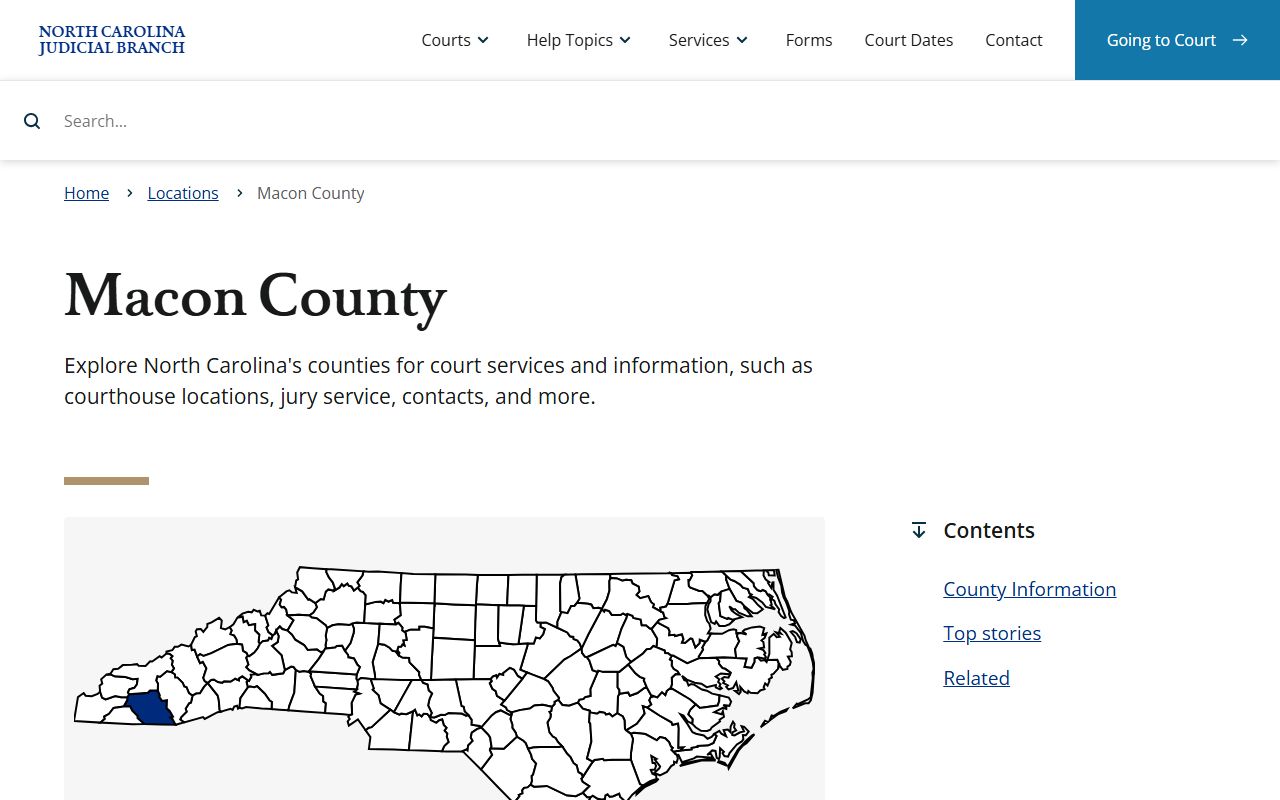
That location page helps confirm that Macon County court record search is tied to the North Carolina Judicial Branch, not a county-created case portal.
Macon County Court System
North Carolina uses one statewide General Court of Justice. In Macon County, the trial courts are Superior Court and District Court. Superior Court is the higher trial division for felony criminal cases, larger civil matters, special proceedings, jury trials, and appeals from District Court. District Court handles misdemeanors, infractions, traffic cases, domestic matters, juvenile matters, small claims appeals, and many first-stage criminal proceedings.
The Clerk of Superior Court is the record custodian for both trial divisions. In estate matters, the Clerk also acts as the probate authority. Appeals from Macon County trial courts generally move to the North Carolina Court of Appeals, with the Supreme Court of North Carolina as the highest state court. Federal cases are separate and go to the Western District of North Carolina.
Case flow: Magistrate or District Court › Superior Court when required › North Carolina Court of Appeals › Supreme Court of North Carolina.
| Court | Jurisdiction | Case Types |
|---|---|---|
| Macon County Superior Court | Higher trial division | Felonies, major civil cases, special proceedings, jury trials, District Court appeals |
| Macon County District Court | Lower trial division | Misdemeanors, infractions, traffic, domestic, juvenile, small claims appeals |
| Clerk of Superior Court | Record custodian and estate authority | Court files, certified copies, estates, special proceedings, public terminals |
| Magistrate / Small Claims | Limited local functions | Small claims, summary ejectment, initial process, some warrants and bond duties |
The official Superior Court page describes the higher trial division used by Macon County felony, civil, and special proceeding records.
Superior Court context matters because felony and major civil Macon County court records do not follow the same path as routine infractions or small claims.
Macon County Courthouse Contacts
The Macon County Courthouse in Franklin is the main local destination for Superior Court, District Court, Clerk of Superior Court, estate filings, certified court copies, and public counter questions. The Sheriff and Detention Center are at a separate Lakeside Drive location, so live custody and jail questions should not be routed first to the courthouse. The Register of Deeds is also a separate records channel for marriage licenses, vital records, land records, and recorded instruments.
Macon County Courthouse
5 West Main Street
Franklin, NC 28734
828-349-7200
Monday-Friday, 8:00 a.m.-5:00 p.m.
Macon County Sheriff's Office
1820 Lakeside Drive
Franklin, NC 28734
828-349-2104
Use for sheriff, detention, and enforcement questions.
Macon County Register of Deeds
Franklin, North Carolina
Use for marriage, vital, and recorded land records.
The official courthouse listing gives the courthouse address, public parking note, building hours, and court phone numbers.
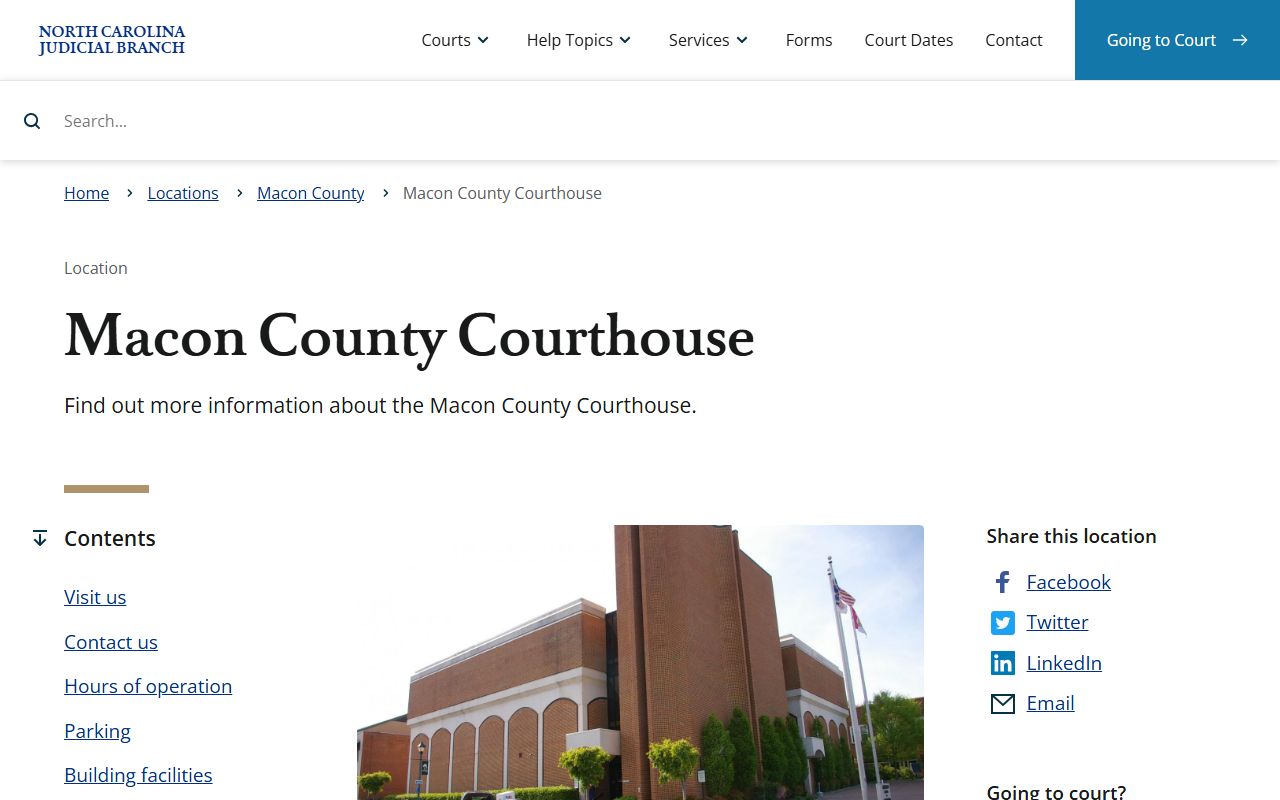
The courthouse listing is the best source for arrival details because parking rates, special security lines, and public transit routes were not published in the research sources.
Types of Court Records Available in Macon County
Macon County court records include civil cases, criminal cases, court charges after arrest, family and divorce files, estate files, traffic and infraction matters, small claims, eviction records, judgments, and protective-order matters. The office that holds the record depends on the record type. Court case files route through the Clerk and eCourts. Marriage certificates route through the Register of Deeds. Jail custody status routes through the Sheriff and Detention Center.
Some records are public, some are partly redacted, and some are restricted by law or court order. Juvenile files, adoption proceedings, sealed records, expunged criminal records, mental health proceedings, protected addresses, financial account numbers, and minor information should not be expected in a normal public search.
- Criminal records include warrants, indictments, pleas, motions, judgments, sentencing orders, probation terms, and financial obligations.
- Civil records include complaints, answers, motions, service returns, orders, judgments, liens, and satisfaction entries.
- Family and divorce records include divorce judgments, custody, support, equitable distribution, and domestic matters, with some sensitive limits.
- Estate records include wills, letters, inventories, accountings, creditor notices, guardianships, and special proceeding documents.
- Traffic records include citations, pleas or waivers, dispositions, costs, compliance entries, and failure-to-appear events.
What Macon County Court Records Show
A Macon County court record usually reads as a case history. It may show the file number, division, county, party names, attorney names, filing date, status, docket events, hearing data, financial obligations, document entries, and redactions. Criminal case records can also show charges, offense descriptions, statute references, bond events, pleas, dispositions, sentencing entries, and probation conditions. Civil and estate records show different fields because the dispute or filing type is different.
| Field | What It Shows |
|---|---|
| Case number | The court's file identifier, useful for exact Portal and Clerk searches. |
| Filing date | The date a complaint, petition, citation, warrant, or estate file opened. |
| Parties | Plaintiff and defendant, state and defendant, petitioner and respondent, or estate parties. |
| Docket events | Filings, service, hearings, motions, orders, continuances, pleas, judgments, and appeals. |
| Disposition | The outcome of a charge or case, such as dismissed, guilty plea, judgment, or closed estate. |
| Sentence or judgment | Court-ordered punishment, probation, costs, restitution, civil judgment, or other final order. |
Public Access Laws for Macon County Court Records
North Carolina public records law supports inspection and copying of public agency records, but court records also follow court-specific statutes, judicial rules, sealing orders, and confidentiality laws. For Macon County court case files, the practical public access path is eCourts Portal, court-date search, and then the Clerk of Superior Court for certified copies, older files, public terminals, and records that do not show online. Sheriff's Office and county administrative records follow the custodian that keeps them.
Key Statutes:
N.C.G.S. §132-1 defines public records broadly for North Carolina public agencies.
N.C.G.S. §132-6 requires inspection and copies unless another law restricts access.
N.C.G.S. §7A-109 requires the Clerk of Superior Court to keep court records, indexes, dockets, and minutes.
Chapter 15A, Article 5 governs arrest warrants and related criminal process.
The Judicial Branch court-records help topic explains public access, copies, and the role of the Clerk's Office.
That statewide help topic is useful when a Macon County Portal result does not answer copy, certification, or access-limit questions.
Restricted Macon County Court Records
Not every Macon County court record is open to the public. Juvenile delinquency, abuse, neglect, dependency, adoption, involuntary commitment, sealed, and expunged records have access limits. The public Portal may show no entry, a limited event, or a redacted version. Personal identifiers such as Social Security numbers, financial account numbers, protected addresses, minor information, medical details, and some victim information can be withheld or blacked out.
Expunction is a formal court process. A person must identify the exact case, determine whether North Carolina law allows expunction, file the proper petition in the county of the charge, and wait for court and agency processing. A Clerk cannot remove a public criminal record just because someone asks at the counter.
Macon County Specialty Programs
No official Macon-specific specialty court page was located in the research sources. That matters because a named Veterans Treatment Court, Adult Drug Treatment Court, Mental Health Court, Family Treatment Court, or DWI Court should not be invented for Macon County. Local defendants may still encounter treatment referrals, supervised probation, diversion, conditional discharge, or specialty calendar practices through judges, prosecutors, probation, or community programs, but those are not the same as a confirmed standalone court.
Macon County Sheriff and Jail Records
The Macon County Sheriff's Office handles county law-enforcement records, detention, warrants, civil process, and many arrest records. The Detention Center is at 1820 Lakeside Drive in Franklin. The research did not locate an official county-hosted public jail roster or a verified Sheriff's Office mobile app. Current custody questions should therefore start with the Sheriff's Office or Detention Center, while sentenced state-prison records should be checked through the North Carolina Department of Adult Correction offender search.
Arrest and booking records are not the same as filed court case records. Once charges are filed, the court case, charges, hearings, and disposition move through eCourts and the Clerk. The more detailed custody path is covered in Macon County inmate records, while active process and missed-court issues are covered in Macon County warrant records.
Marriage, Divorce, and Estate Records
Macon County marriage and divorce searches split between two systems. Marriage licenses and certified marriage certificates are Register of Deeds records. Divorce filings and divorce judgments are court records searched through eCourts and the Clerk of Superior Court. Probate is also a Clerk function because the Clerk acts as the estate authority for many North Carolina probate matters.
- Testator
- A person who died after making a will.
- Executor
- The person named in a will to administer the estate after appointment.
- Administrator
- A person appointed when there is no will or no executor can serve.
Macon County Court Records Fees
Court fees in Macon County should be checked through the current North Carolina Judicial Branch court costs page. The research file did not capture reliable current dollar amounts for every copy and filing service, and the build should not invent them. Estate costs also depend on current statewide schedules and N.C.G.S. §7A-307. Register of Deeds costs belong to the Register, not the Clerk.
| Item | Amount |
|---|---|
| Civil filing fees | Use the current Judicial Branch civil costs chart. |
| Criminal costs | Use the current criminal costs chart and case judgment. |
| Estate costs | Use the estates chart and N.C.G.S. §7A-307. |
| Certified court copies | Confirm the current copy and certification fee with the Clerk. |
| Marriage and vital copies | Use the Macon County Register of Deeds fee guidance. |
The official eCourts information page explains Portal, File & Serve, Guide & File, and county rollout context.
That eCourts context is especially important for Macon County because the July 22, 2024 Track 5 rollout changed how many users reach modern case information.
Interpret Macon County Court Records
Read a Macon County court record from the top down. Start with the case type and court division, then match the party names and filing date. Next, review the docket entries in date order. A charge is an allegation or filed offense. A conviction is a guilt finding or guilty plea. A disposition is the outcome of a charge or case. A judgment is the court's enforceable decision. A sentence is the punishment or set of conditions after conviction.
Accuracy and Record Limitations
Online Macon County court records are useful, but they do not replace the official file. Some documents may be unavailable online. Some entries may be redacted. Older files may require Clerk review or archive handling. A live custody status can also change faster than a filed court case, so inmate questions should be checked with detention staff. A marriage certificate may be at the Register of Deeds even when a related divorce is in the court system.
Note: Confirm urgent court dates, warrants, and certified-copy needs with the office that holds the original record.
History of Macon County Courts
Macon County was formed in 1828, and Franklin is the county seat. Local court history is tied to western North Carolina's courthouse-square government and the later statewide unification of North Carolina's court system. Older records may use terms that differ from the modern Superior Court, District Court, Clerk of Superior Court, and eCourts structure. Estate records can also intersect with Register of Deeds records when a court file leads to deeds or recorded instruments.
The county's mountain geography still affects access. People traveling from Highlands, Nantahala, Otto, Cowee, Cartoogechaye, and other communities may need to plan more time for hearings in Franklin. Court-date lookup and phone confirmation are useful because missed court can lead to an order for arrest or license consequences even when travel is difficult.
The official District Court page explains the trial division that handles Macon County misdemeanors, infractions, traffic, domestic, juvenile, and small-claims appeal records.
That distinction helps explain why not all Macon County court records are Superior Court files.
Frequently Asked Questions
Where do Macon County court record searches start?
Start with the North Carolina eCourts Portal for public case information. Use court-date search for hearing dates, online services for citation payment paths, and the Macon County Clerk of Superior Court for certified copies or files that do not appear online.
Does Macon County have a separate probate court?
No separate probate courthouse was identified. Estate and probate matters are handled by the Estates Division of the Clerk of Superior Court because the Clerk serves as the probate authority for many North Carolina estate matters.
Are marriage and divorce records in the same office?
No. Marriage licenses and certified marriage certificates belong to the Macon County Register of Deeds. Divorce decrees and domestic case files are court records handled through eCourts and the Clerk of Superior Court.
Is there an official Macon County warrant search?
No official online active-warrant list was located in the accessible Sheriff's Office sources. Warrant questions should be checked through the Sheriff's Office, court case search, court-date search, the Clerk, or counsel.
What changed with eCourts?
Macon County became part of eCourts Track 5 on July 22, 2024. Portal, File & Serve, Guide & File, and related electronic workflows now shape many modern case searches and filings.